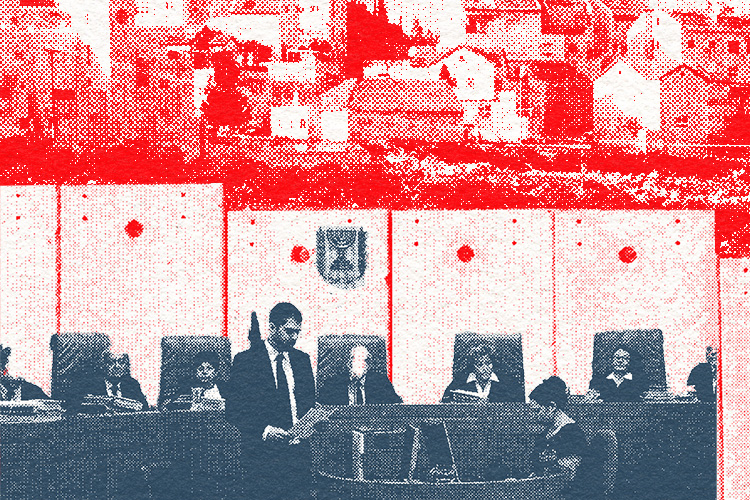
The Supreme Court is perceived in Israel as a gatekeeper whose role it is to check the government’s power and protect the rule of law in Israel. In recent years, the Israeli judiciary has drawn sharp criticism from some Israeli politicians, who present the Supreme Court as excessively interventionist in the political echelon’s decision making and meddlesome in Israel’s policy of control in the West Bank. This is the backdrop for plans promoted in recent years designed to restrict the judiciary’s independence and limit the Supreme Court’s purview. Nevertheless and despite its image as an institution that reins in the government, the Supreme Court has played a longstanding role in providing legitimacy for policies and mechanisms that enable Israeli control in the Occupied Palestinian Territories and normalizing them as part of system of governance that operates in an allegedly lawful manner.
Throughout the decades-long occupation the Supreme Court has intervened in Israel’s policy in the West Bank and even occasionally limited the State’s actions in the occupied territory. For example, in the 1979 Dweikat case (known also as the Elon Moreh judgment) the Court forbade the practice of issuing a military requisition order for seizing privately-owned Palestinian land in order to build a settlement without any military need. In 2020 it struck down the so-called Regularization bill designed to retroactively authorize unlawful construction in settlements and outposts located on privately-owned Palestinian land.
And yet, even though it did set certain boundaries for the State’s actions, the Court has consistently refrained from deliberating principled and systemic questions concerning the occupation regime, chiefly the legality of the settlement enterprise itself and has rejected numerous crucial petitions challenging various practices Israel exercises to reinforce its control over the occupied territory.
For example, in 1993, the Court rejected a petition asking to determine that the settlement policy in the Occupied Palestinian Territories is illegal because it found this to be a political matter and therefore unjusticiable. In its judgements concerning the Separation Wall, the Court found that Israel may build the Separation Wall in the West Bank territory for security needs. This is contrary to the International Court of Justice (ICJ)’s advisory opinion published in 2004, which held that establishing the Separation Wall in the occupied territory and Israel’s accompanying policy of control contravenes international law because it could be tantamount to de-facto annexation. In 2011, the Court rejected Yesh Din’s petition against Israeli mining operations in the West Bank and the transfer of natural resources to Israel, thereby legalizing blatant colonialist exploitation of resources embedded in the occupied territory. In 2014, the Court rejected a petition submitted by eight human rights organizations against the policy of punitive house demolitions and thus permitted the Military Commander to exercise this practice. In 2022, the Court rejected the residents of Masafer Yatta’s petition against declaring their residential area as Firing Zone 918, paving the road to the forced displacement of over one thousand people. That same year, in a majority opinion, the Court retroactively authorized the outpost of Mitzpe Kramim, which was built on privately-owned Palestinian land and determined that the outpost must not be evacuated. This ruling created a mechanism that could be utilized to retroactively authorize thousands of additional settlement and outpost structures built on privately-owned Palestinian land.
These rulings reflect the Supreme Court’s role in shaping the legal framework for Israeli control over the West Bank and its stamp of legality for the mechanisms that have reinforced this control and established the settlement enterprise. In doing so, the Court has helped legally normalize the settlement enterprise even though settlements contravene international law by definition.
This pattern is also evident in petitions against more obvious annexation measures. In January 2026, the Court rejected a petition submitted by Yesh Din and the Association for Civil Rights in Israel against relegation of governing powers from the Military Commander to Minister Bezalel Smotrich and the Deputy Head of the Civil Administration for Civil Affairs. During the hearings, the Court brought to the amendment of some of the arrangements, yet the transfer of authority itself stands. That very same month, the Court rejected the petition submitted by Yesh Din, Bimkom, the Association for Civil Rights in Israel and Hamoked – Center for the Defence of the Individual against resumption of settlement of title to land proceedings in the West Bank on the grounds that it is “premature” and refrained from deciding in the petitioner’s claim that this measure constitutes annexation. In both instances, the Court refrained from limiting measures that fundamentally alter the nature of Israeli control in the West Bank and transform it from a temporary military regime to mechanisms typical of a permanent and sovereign government. In doing so, the Court has left annexation measures in place and enabled their advancement.
Settlement expansion, like the intensification of Israeli control in the West Bank are apparatuses in the process of annexing the West Bank to Israel. The International Court of Justice’s Advisory Opinion from 2024 found that the Israeli settlement policy, including settlement expansion, building infrastructure for settlers, the Separation Wall and utilizing the West Bank’s natural resources entrench Israeli control over the occupied territory and “amount to annexation of broad parts of the Occupied Palestinian Territory”. The Supreme Court’s judgements have contributed to legitimizing these mechanisms and provide a mantle of legality for actions that have reinforced Israeli control in the occupied territory, helping to transform what is intended to be a temporary regime of occupation into a permanent system of governance. Over time, this jurisprudence has created the legal and institutional infrastructure used for the more overt annexation measures now being advanced. In this sense, the Court is part and parcel of the legal apparatus that has enabled the process of annexing the West Bank to Israel to be reinforced and entrenched.

 Disable/Enable big cursor white
 Disable/Enable big cursor black