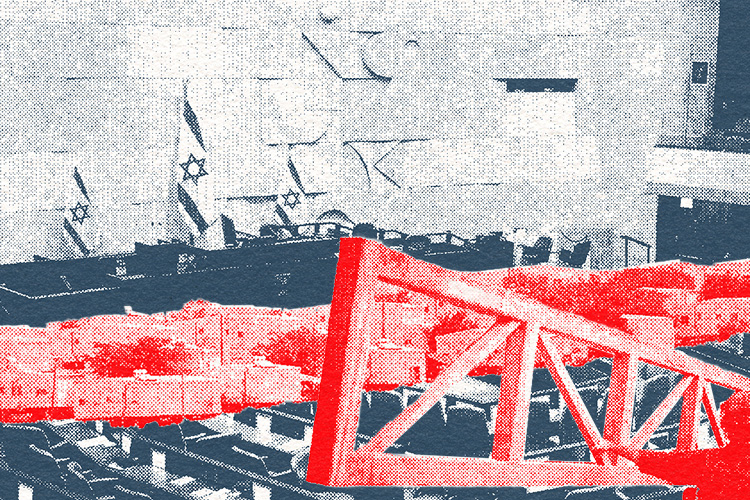
The Security Cabinet, officially titled the Ministerial Committee on National Security, is a small forum of Israeli government ministers authorized to make decisions with binding force on matters of security and foreign affairs, as well as on any other issue the Prime Minister determines warrants its attention. Its decisions, though made by a restricted group of ministers rather than the government, have the same binding force as government resolutions and cannot be appealed before the government plenum.
Unlike government resolutions, which are made available to the public on the Prime Minister’s Office website, the Security Cabinet’s meeting dates, deliberations and decisions are classified. Consequently, the public is made aware of the substance of its decisions and sometimes of their very existence, retrospectively, through statements by ministers, media reports or measures taken to implement them.
In recent years, Security Cabinet decisions have been used to reshape the system of governance in the West Bank in the fields of land, planning and settlement expansion, and to extend Israeli control into Areas A and B, which are under Palestinian civilian authority. Through a restricted forum of ministers, and at times, without the wording of the decisions or their full implications being disclosed to the public, thereby precluding the possibility of challenging or criticizing them, the Security Cabinet serves as a central mechanism for advancing the annexation of the West Bank.
In June 2024, the Security Cabinet extended Israeli enforcement powers into Area B, partly under the pretext of protecting the environment and archaeological sites. The decision allows the Archaeology Staff Officer at the Civil Administration to operate in areas where civilian powers have been transferred to the Palestinian Authority, order work and development to cease, issue fines and even demolish structures in areas designated as archaeological sites or potential archaeological sites. At the same meeting, the Security Cabinet also decided to recognize five unauthorized outposts as official settlements.
In May 2025, the Security Cabinet approved the resumption of settlement of land title proceedings in Area C, a move that allows Israel to conclusively determine land ownership after the process had been frozen since 1967 (for more information, see: Resumption of Settlement of Land Title in the West Bank). That same month, the Security Cabinet approved the establishment of 22 settlements: nine new, 12 retroactively approved outposts and one neighborhood in an existing settlement converted into an independent settlement. Many of these settlements are located deep inside the West Bank. In December 2025, the Security Cabinet approved 19 settlements, including the re-establishment of settlements removed from the northern West Bank under the 2005 Disengagement Plan, as well as additional settlements in areas previously free of Israeli presence.
In February 2026, the Security Cabinet advanced the annexation policy further by approving a series of decisions intended to transform the land regime in the West Bank, remove restrictions and oversight mechanisms governing land purchases, and change the distribution of powers in the West Bank. The measures were formulated under the leadership of the Settlement Administration in the Ministry of Defense, with the aim of accelerating settlement development. For example, the Security Cabinet decided to lift the confidentiality restrictions on the land registry and make land records available to the public; repeal the Jordanian law restricting land purchases by foreigners, thereby allowing Israelis to purchase land directly, without the need for a company registered with the Civil Administration; abolish the permit and licensing mechanisms currently applicable to land transactions; and reinstate, after some two decades, state-initiated land purchases.
Within a discriminatory land regime, in which Israel allocates public land almost exclusively for settlement purposes and settler organizations have worked for years to locate and take over Palestinian land, sometimes through questionable means, these decisions expand the tools available for transferring land to Israeli control. Meanwhile, following the Security Cabinet’s June 2024 decision to extend the Civil Administration’s enforcement activities to Area B, the Security Cabinet decided to apply a similar arrangement in Area A in matters concerning archaeology, the environment and water. Given there are thousands such sites throughout the West Bank, this creates a broad enforcement tool that can be used to restrict Palestinian construction and development and expand Israeli control.
The decision also permanently strips the Hebron Municipality of all powers related to planning and permits in the Jewish settlement in the city, the Cave of the Patriarchs and other sites and transfers them to Israeli planning authorities. It also vests the Hebron Administration, the Israeli body responsible for managing the civilian affairs of settlers in Hebron with full municipal powers. In addition, an Israeli municipal administration vested with powers to manage, maintain and develop Rachel’s Tomb in Bethlehem will be established. These measures allow Israel to intervene in Palestinian planning and construction even in areas where civilian powers were transferred to the Palestinian Authority under the Oslo Accords.
In March 2026, the Security Cabinet approved 34 settlements: 24 new and 10 retroactively approved outposts. The decision was classified and became public knowledge only about two weeks after it was made. In June 2026, the cabinet approved ILS 1.3 billion (approximately USD 370 million) to fund the establishment of the new settlements. In July 2026, the cabinet approved establishing another settlement, Sa-Nur East, south of Jenin, on the site of a former military base.
These examples illustrate how the Security Cabinet has become a key government tool for advancing the annexation of the West Bank. As a restricted forum of ministers whose decisions are binding, but debated and delivered out of public view, the Security Cabinet enables advancing far-reaching changes to the land and planning regime and the distribution of powers, as well as settlement expansion, at times indirectly and without public scrutiny. These decisions gradually transform the regime applied in the West Bank: they deepen Israeli control, curtail the Palestinian Authority’s powers and increase the harm to Palestinians’ rights, including the risk of loss of land rights and dispossession.

 Disable/Enable big cursor white
 Disable/Enable big cursor black