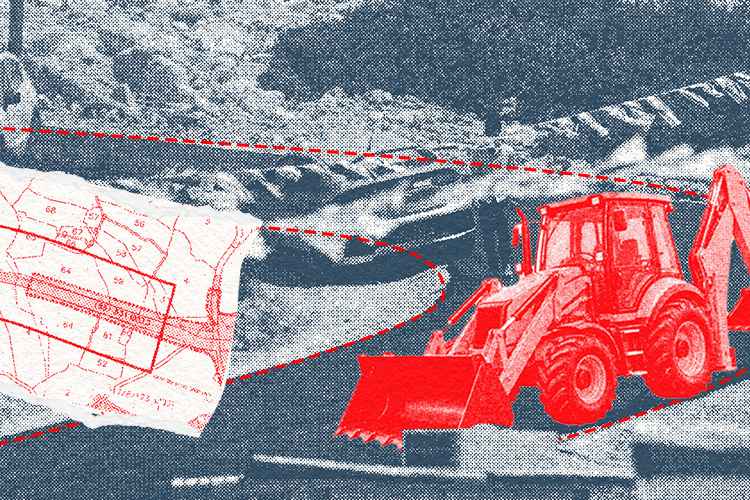
The effort to deepen Israeli control over the West Bank and expand the settlement enterprise relies on extensive investment in roads and infrastructure, meant to improve living conditions in settlements, connect them to one another and to Israel, and encourage Israelis to move there. These measures are part of a broader effort to expand Israeli presence and entrench Israeli control in the West Bank.
Road development involves expropriating Palestinian land, increasing segregation between Israelis and Palestinians on the roads, and a major commitment of public funds. For instance, for the construction of the Huwarah bypass road, 406 dunams of privately owned Palestinian land were expropriated. For the al-Funduq bypass road, Israel issued a seizure order for 216 dunams, and construction alone is estimated to cost approximately ILS 200 million (~ USD 65 million). The main roads primarily serve Israelis, while Palestinian residents are forced to use alternative routes.
The road known as Sovereignty Road, near Ma’ale Adumim, offers a particularly glaring example of the link between infrastructure investment and annexation. This road is intended to create a contiguous Israeli area between Jerusalem and Ma’ale Adumim and enable Israel to close off Area E1 to Palestinians. It will create a separate road system for Israelis and Palestinians, in other words, an apartheid road, and in conjunction with construction in E1, will cut East Jerusalem off from the rest of the West Bank, undermining territorial contiguity between the northern and southern West Bank. The Civil Administration Fund allocated ILS 335 million (~ USD 109 million) for the project.
Additional infrastructure investments further integrate the occupied territory into Israeli systems and exploit Palestinian land and resources for the benefit of Israel and the settlements. In October 2024, the government decided to advance the construction of two power plants and allocate approximately 2,000 dunams in Area C for solar fields that would be integrated into Israel’s energy sector. At the same time, Israel is working to restrict the development of independent Palestinian energy infrastructure.
In June 2025, the government allocated ILS 35 million (~ USD 11.38 million) to erect cellular antennas in West Bank locations chosen to serve settlers’ needs. Both the antennas and the Sovereignty Road are funded through the Civil Administration’s off-budget fund, which receives, among other sources, money collected from the Palestinian population. The fund is meant to support development in the area and benefit the local Palestinian population. In practice, however, the money is diverted to settlements. In other words, Palestinians living under occupation are paying for infrastructure designed to restrict their movement and expand settlements.
Illegal Road Construction by Settlers
Alongside official roads planned and built by state authorities and the military, settlers have cleared hundreds of unauthorized roads since 2023, totaling 223 kilometers. They connect outposts and settlements, open new areas to settler activity, and enable settlers to take over land and drive Palestinians out. According to Peace Now monitoring, approximately 110 kilometers of these roads cross privately owned Palestinian land or land not designated as state land, and some 4.8 kilometers were cleared in Area B. The practice was also noted in a summary of a discussion chaired by the GOC Central Command in March 2024, which clarified that roads needed for security purposes are built lawfully by the military.
Rather than remove these unauthorized roads and return the land to its owners, the state is seeking to retroactively approve some of them and turn them into official projects. Where a road crosses privately owned Palestinian land, the military may issue an order to seize it. This occurred in 2023 with roads built by settlers near Eli and Kiryat Arba. International law permits land seizure only for urgent security needs. These cases demonstrate how security necessity is stretched to accommodate settlers’ whims and used to retroactively approve roads built for settlements and advance Israeli settlement interests.
Roads, power plants and communications networks enable settlements to expand and absorb hundreds of thousands of additional settlers, while integrating the occupied territory into Israel. While connecting settlements to one another and to Israel, they also drive the expropriation of Palestinian land, separate communities and restrict Palestinians’ movement and opportunities for development. In this way, Israel is reshaping the West Bank as if it were its sovereign territory and advancing annexation.

 Disable/Enable big cursor white
 Disable/Enable big cursor black