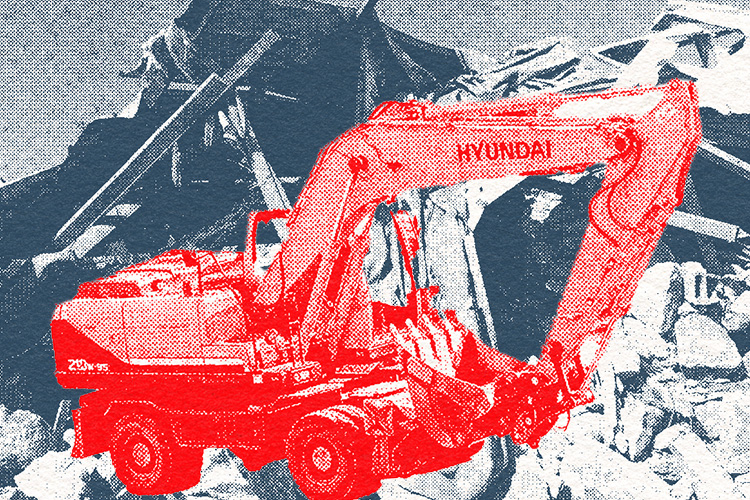
Throughout most of the occupation, Israel demolished Palestinian construction in the West Bank while refraining from demolishing outposts and many other structures built by Israeli settlers without permits. The discriminatory enforcement policy intensified after Bezalel Smotrich took office as Additional Minister in the Ministry of Defense and the Settlement Administration was established in 2023. Smotrich and the settlement movement have openly made it their goal to curb Palestinian development in Area C, as part of what they call “the battle for Area C.” Accordingly, demolitions of Palestinian construction in Area C accelerated, and in some cases, enforcement extended into Areas A and B, where Israel holds no authority over planning. At the same time, although the number of permit-less structures built by Israelis surged during this time, enforcement against illegal construction by settlers all but ground to a halt.
Most Palestinian structures in the West Bank are demolished on the grounds that they were built without permits, yet it is practically impossible for Palestinians living in Area C to obtain one. Israel’s planning regime almost entirely blocks lawful Palestinian construction, forcing Palestinians to build without permits and thereby creating the grounds for demolishing their homes. For example, according to Bimkom data, Palestinians submitted 5,071 building permit applications between 2021 and 2024, but only 22 were approved (approximately 0.4%). In 2025, none of the 1,022 residential planning applications Palestinians submitted were approved. During these same years, Israel advanced plans and permits for tens of thousands of housing units in settlements.
Since 2023, demolitions of Palestinian structures have spiked and selective enforcement against Palestinians has grown more entrenched. According to Bimkom, in 2024, the Israeli authorities issued demolition orders for 946 Palestinian structures, of which 862 were demolished. That same year, the authorities issued demolition orders for 280 structures built by settlers without permits, but demolished only 39. In other words, the authorities demolished approximately 91% of Palestinian structures subject to demolition orders, compared with approximately 14% of structures built by settlers subject to such orders. In 2025, the Israeli authorities demolished 962 of the 1,005 Palestinian structures subject to demolition orders: approximately 96%, compared with only approximately 20% of structures built by settlers (58 of 296).
Data from the United Nations Office for the Coordination of Humanitarian Affairs (OCHA) also show a sharp increase in demolitions of Palestinian structures in the West Bank. According to the UN office, since 2024, the average number of structures demolished in Area C and East Jerusalem each month has been at least twice the average recorded in the preceding 15 years. In 2023, the Israeli authorities demolished 676 structures for lack of building permits. In 2024, the number rose to 1,066, an increase of approximately 58%. In 2025, 1,280 structures were demolished for lack of building permits, the highest annual figure recorded by OCHA. In 2026, the authorities had demolished 773 Palestinian structures by August. In total, since the beginning of 2024, 3,795 structures have been demolished for lack of building permits; 42 were in Areas A and B, and the remainder in Area C. The demolitions displaced 857 Palestinians from their homes. In all, almost 50,000 people were harmed or affected by the demolition of residential and agricultural structures and infrastructure they used. According to UN data, in addition to home demolitions carried out on the grounds of a lack of building permits, 475 Palestinian structures were destroyed during this period in military operations or punitive demolitions.
One factor behind the surge in demolitions and the intensification of discriminatory enforcement is the transfer of control over enforcement operations in Area C to the Settlement Administration, a civilian body subordinate to Smotrich. In the past, only operations considered sensitive or potentially explosive were submitted for approval by the political leadership. Since March 2023, however, almost every operation against illegal settler construction has required the Settlement Administration’s approval. In practice, since these powers were transferred to the Settlement Administration, enforcement against illegal Israeli construction has taken place only in exceptional cases. According to the summary of a discussion chaired by then GOC Central Command Yehuda Fox, the Settlement Administration routinely approved all enforcement action against Palestinian construction, while withholding approval for action against illegal settler construction, including in cases where the state had undertaken to carry out enforcement in court proceedings. Fox stated that, as a result, enforcement against illegal Israeli construction had been “reduced to the point of disappearing,” creating a “growing and widening gap” between it and enforcement against Palestinian construction.
As the decision-making process was changed, the government also increased the resources available to the Civil Administration’s Enforcement Unit to enhance capacity for identifying Palestinian construction classified as illegal, issuing orders, and carrying out enforcement and demolition actions. According to Peace Now, between 2021 and 2024 the unit’s budget increased from approximately ILS 16.9 million (~ USD 5.54 million) to approximately ILS 26.5 million (~ USD 8.68 million). Staff positions increased from 54 to 67. In 2025, the unit’s budget was approximately ILS 25.3 million (~ USD 8.29 million). In 2024–2025, the government gave approximately ILS 67 million (~ USD 21.95 million) through the Ministry of Settlement to fund “land patrol units” operated by local authorities in the settlements and tasked with identifying Palestinian construction and land cultivation and reporting them to the Civil Administration. This brought the authorities that represent settlers into the system of identification and reporting used for enforcement against Palestinians and intended to expand the land reserves of the settlements themselves.
In its bid to enhance enforcement and demolition capacities in Area C, the government has integrated another civilian agency into Israel’s enforcement apparatus. In the past, the Civil Administration enforcement unit, part of the military governing system, had exclusive authority over planning and building. In 2025, the government decided to establish a dedicated enforcement unit within the Israel Land Authority that would operate in the West Bank too. According to Smotrich, the unit is expected to have approximately 70 employees and draw on the experience, personnel and technological resources of the Israel Land Authority. This move is expected to increase Israel’s capacity to identify Palestinian construction classified as illegal and carry out enforcement actions and demolitions. Integrating the Israel Land Authority, an Israeli civilian body whose powers generally do not extend to the West Bank, into the enforcement apparatus is another step toward transferring control structures in the occupied territory to civilian hands, blurring the distinction between sovereign Israel and the West Bank, and deepening de facto annexation.
Meanwhile, Israel has begun using its enforcement mechanisms in areas under the Palestinian Authority’s civilian jurisdiction. In July 2024, the GOC Central Command signed orders giving Israel the power to prohibit construction and demolish Palestinian structures in the Agreed-Upon Reserve, an area spanning approximately 167,000 dunams in the Judean Desert with status similar to Area B, per the Interim Agreements. In recent years, settlers have pressed for enforcement against construction in the area that they claim is illegal. The orders were first implemented in December 2024, when the Civil Administration demolished Palestinian structures in the Agreed-Upon Reserve. In February 2026, the Security Cabinet authorized the Civil Administration’s enforcement bodies to operate in Areas A and B, which are under the Palestinian Authority’s jurisdiction and administration pursuant to the Oslo Accords, on matters concerning the environment, water and “heritage and archaeological sites.” These categories, which are open to broad interpretation, may serve as grounds for demolishing structures, sealing wells, curbing Palestinian development and expanding Israeli control over archaeological sites, even in cases that do not constitute offenses under Palestinian law.
In its July 2024 Advisory Opinion, the International Court of Justice found that the discriminatory planning regime, extensive demolitions and forced evictions push Palestinians off their land, and that the policy of entrenching Israeli control and creating irreversible facts on the ground, particularly in Area C, amounts to the annexation of large parts of the occupied Palestinian territory.
Preventing Palestinian construction, demolishing structures and infrastructure, and putting pressure on communities are intended to push Palestinians out of areas Israel seeks to control, thereby reshaping the territory. Smotrich himself stated that the purpose of advancing “an entirely new enforcement system” in the West Bank is “geopolitical, strategic and security-related.” Transferring enforcement powers to civilian bodies subordinate to the political leadership and extending Israeli enforcement mechanisms into Areas A and B deepen Israeli control and de facto annexation. These measures form part of a strategy intended to realize a political vision of full Israeli sovereignty over the West Bank, while entrenching Jewish supremacy and confining Palestinians to the smallest geographical area possible.

 Disable/Enable big cursor white
 Disable/Enable big cursor black