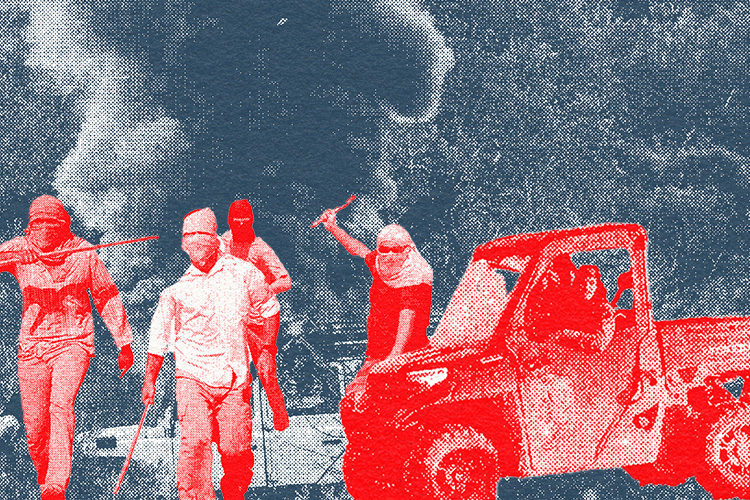
The term ‘settler violence’ refers to ideologically motivated crime committed by Israeli civilians against Palestinians in the West Bank. It includes physical violence, damage to crops and property, and terror and intimidation that disrupt Palestinians’ daily lives throughout the West Bank. These offenses are committed by individuals and groups, but collectively they form a systematic pattern of ideologically motivated violence intended to serve political and territorial objectives: undermining the fabric of Palestinian life, pushing Palestinians off their land and expanding Israeli control over the territory.
Settler violence has reached record-breaking levels in recent years, with daily attacks against Palestinians and their property across the West Bank, some of them fatal. It is not, however, new. Settler violence has been part of Israel’s settlement enterprise from its inception, with varying degrees of intensity, and has long served as a tool for taking over land and advancing political objectives. What has changed in recent years is not the objectives of this violence, but its scale and intensity, the impunity enjoyed by the perpetrators and its more overt and direct integration into Israel’s annexation policy.
Settler violence does not occur in isolation from Israel’s policy of expanding its control over the West Bank. It operates alongside that policy and reinforces it. The state takes over Palestinian land in a variety of ways, including issuing military orders that close off areas, declaring land to be state land and allocating it to settlements, and deploying the planning and building regime. Settler violence, meanwhile, helps drive Palestinians off their land through intimidation and sustained disruption of their daily lives, sparing the state from having to do so directly and officially. In practice, Israeli civilians who carry out systematic, ideologically motivated violence against Palestinians act as subcontractors, putting this policy into practice, while the state maintains the appearance of the rule of law.
Impunity for the perpetrators is a key condition that has sustained this system. For more than two decades, under successive governments, Israeli law enforcement agencies have systematically and persistently failed to investigate and prosecute Israelis who harm Palestinians and their property. Yesh Din’s monitoring data show that 93.6% of investigation files opened between 2005 and 2025 concerning ideologically motivated crime by Israelis against Palestinians ended without an indictment. Police investigations failed in 82% of these cases, and only three percent led to full or partial convictions. This failure, persisting for decades, strips away any deterrent against harming Palestinians. It makes impunity itself part of the mechanism that allows violence to serve as an effective tool for dispossessing Palestinians of their land and expanding Israeli control over the occupied territory.
With the formation of Israel’s 37th government in December 2022, the impunity enjoyed by perpetrators of violence against Palestinians for years received more overt political and institutional support. The coalition agreements laid out a plan for the retroactive approval and expansion of unauthorized outposts, which are known hubs of violence against Palestinians and drivers of expulsion. Bezalel Smotrich received extensive powers over land, planning and building in the West Bank, while Itamar Ben Gvir, as Minister of National Security, assumed responsibility for the Israel Police. Under Smotrich, enforcement against illegal Israeli construction ceased almost entirely, while enforcement against Palestinian construction continued. Minister Ben Gvir meanwhile reportedly instructed the police not to take enforcement action against Israelis involved in acts of terrorism against Palestinians. In November 2024, the commander of the police unit in charge of investigating ideologically motivated crime against Palestinians, the Samaria and Judea District Police Central Unit, was arrested on allegations he had prevented or obstructed investigations into settler violence to curry favor with Ben Gvir and get a promotion.
Institutional support also comes with political legitimization for the violence. Bezalel Smotrich claimed that “the ‘settler violence’ campaign is an antisemitic lie.” Following a shooting in Huwarah in February 2023, in which two settlers were killed, he said that “Huwarah should be wiped out.” In addition, 14 Knesset members signed a petition calling to ease prison conditions for Amiram Ben Uliel, who was convicted of murdering three members of the Dawabsheh family, a couple and their infant son, and severely injuring their toddler son in the village of Duma in 2015. Otzma Yehudit MK Limor Son Har-Melech attended a fundraiser for Ben Uliel’s release, where she called him a “holy righteous man” and claimed he was innocent.
Violence against Palestinians in the West Bank sharply increased in the early months after Israel’s 37th government took office. Between January and September 2023, the United Nations Office for the Coordination of Humanitarian Affairs (OCHA) documented 844 incidents of settler violence, compared with 474 during the same period in 2022. After the October 7, 2023 attack, settler violence escalated dramatically in both scale and severity. With public attention focused on the Israeli communities affected by the attack and Israel’s military assault on the Gaza Strip unfolding in the background, settlers took advantage of the situation to carry out organized, violent raids throughout the West Bank. Between October 7 and November 20, 2023, Yesh Din documented 225 incidents of settler violence in 93 villages and towns throughout the West Bank.
At the same time, the military rapidly mobilized thousands of settlers for reserve duty, emergency response teams and “regional defense” units. At their peak, approximately 8,000 regional defense soldiers were deployed in the West Bank, and their duties were expanded to include patrols, setting up checkpoints and “offensive operations in the heart of villages.” The military also armed many additional settlers. In total, approximately 8,000 firearms were distributed to Israeli civilians in the West Bank. The protocols governing firearm distribution allowed residents of outposts and farm outposts to receive them, including those living in sites considered illegal under Israeli law, some of which serve as hubs of violence and harassment against Palestinians.
Since the start of the war in Gaza, thousands of incidents of violence against Palestinians and their property have been documented in the West Bank, many within Palestinian villages and communities near settlements. Although most of the violence occurs in Area C, in recent years it has spread into Area B as well, and even Area A, affecting communities and areas outside Israeli civilian control. According to OCHA data, 1,291 incidents of settler violence against Palestinians in the West Bank were documented in 2023, rising to 1,449 in 2024. In 2025, the violence reached a record high of 1,836 incidents, an average of slightly more than five attacks a day. The trend continued in 2026: 1,197 incidents were documented between January and June alone. At least 45 Palestinians were fatally shot in violent incidents involving settlers between January 2023 and June 2026.
In many incidents, armed settlers in civilian clothes acted alongside settlers in uniform and soldiers. In some, settlers used military-issued firearms and uniforms and powers delegated by the military to harm Palestinians. Alongside cases in which soldiers stood by without intervening to stop settler violence, incidents were also documented in which soldiers themselves joined settlers in attacking Palestinians.
Settler violence, combined with military violence, is effecting tangible and irreversible changes on the ground. It has driven the largest wave of displacement of Palestinian communities in the West Bank since 1967. According to B’Tselem’s data, as of July 2026, 65 Palestinian communities, a total of 4,349 people, had been forcibly displaced from their homes. In 18 additional communities, 512 residents were displaced following violence, threats and sustained harassment by settlers. Although the displaced communities are not formally prohibited from returning, in practice returning is impracticable as long as the threats persist and the military does not protect them from settler violence. In this way, the displacement of communities serves as a tool of the annexation policy: reducing Palestinian presence in the territory and expanding the area under Israeli control.
Although the State of Israel sometimes formally disavows settler violence and even condemns it, in practice it creates the conditions that allow this violence to persist, expand and achieve results on the ground. This is not merely a failure of law enforcement, but a system that serves Israel’s territorial objectives. Settler violence functions as the implementing arm of Israel’s annexation policy: a means of reshaping the West Bank, pushing the Palestinian population into small, isolated enclaves and expanding Israeli control over the territory, without incorporating its Palestinian residents.

 Disable/Enable big cursor white
 Disable/Enable big cursor black