
The olive harvest season is fertile ground for acts of violence against Palestinians by settlers. This year too, the olive harvest season, which began in early October, was steeped in settler violence – physical assault, disruption of the harvest, vandalism of olive trees, theft of agricultural equipment and crops, and the expulsion of Palestinian farmers from their land by force or threats.
These acts of violence and vandalism occurred throughout the West Bank – from north to south, in Area C and, this year more than in previous years, also in areas defined as Area B. In many places, Palestinian farmers were unable to harvest their trees at all this year.
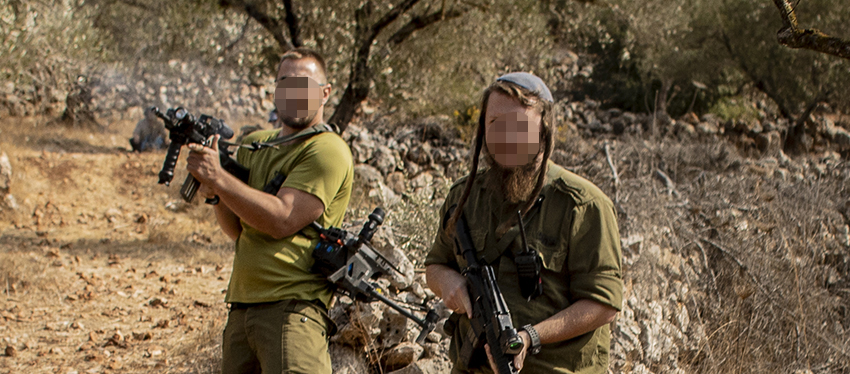
This year, the involvement of Israeli security forces in efforts to prevent the harvest was strongly felt. In large areas, the military prevented the harvest altogether by putting farmland under closure orders and denying landowners access to it for prolonged periods. In addition, oftentimes, soldiers, Border Police officers, and settlement security personnel were present during incidents in which settlers physically prevented Palestinians from harvesting. Not only did they fail to stop the settlers from attacking the harvesters, in many cases, they also prevented the Palestinians from reaching their land and harvesting.
In areas where “coordination” is required for the harvest – that is, where Palestinians are required to get a permit from the army to access their land and harvest – coordination was given very late in the season and for a very short period of one or two days, which precluded farmers from completing the olive harvest. Scheduling dates so late in the season is harmful, as the fruit may rot, thus reducing the quality of the olive oil produced from it. In addition, having no access to the land until such a late stage in the season means settlers from nearby outposts can steal the crop, while the Palestinian farmers can do nothing to prevent the theft. In practice, the “coordination mechanism” ostensibly created by the military to protect Palestinians from settler violence and allow them to harvest safely has been a highly effective tool for preventing the harvest for many years.
OCHA data: An average of about three incidents per day during the harvest season
Between 1 October and 30 November 2025, the UN Office for the Coordination of Humanitarian Affairs (OCHA) documented 178 harvest related settler attacks resulting in casualties, property damage or both, an average of about three incidents per day. These incidents included assaults on farmers in the olive groves or on their way there, theft of crops and harvesting equipment, as well as vandalism of olive trees and other trees and saplings. This exceptionally high figure follows last year’s olive harvest season data, when an unprecedented 213 incidents of assault and disruption of the harvest were recorded in October–November 2024. By comparison, up to 2023, OCHA recorded between 30 and 60 incidents per olive harvest season.
In terms of geographic distribution, the violence this year was spread over a wider area than in the past: incidents were documented in 88 Palestinian cities, towns, and villages, four times the number recorded in 2020, and twice the number in 2022. The number of olive trees and saplings damaged this year also reached the highest level in the past six years, with more than 6,000 trees and saplings vandalized in 2025, compared to about 3,700 trees last year.
This escalation in harvest-related attacks and disruptions took place amid record-breaking settler violence in the West Bank in 2025: October 2025 was the most violent month since OCHA began collecting data in 2006, with 264 settler attacks, an average of 8.5 incidents per day. In total, 1,485 incidents of settler violence were recorded between 1 January 2025 and the end of October that year.
15-16 October 2025, south of Kisan: Settlers picked olives in a Palestinian plot, vandalized trees and property, and violently expelled a Palestinian family of harvesters
M. is a resident of the village of Kisan in the Bethlehem district. He owns a plot of land south of Kisan with about 50 olive trees, 40–45 years old. Until last August, M. lived on the plot, but following the establishment of a new outpost and harassment and threats by settlers, he and his family were forced to leave their home and move in with his parents in Kisan.
On 15 October 2025, M. went out to his plot to harvest the olives with his father and brother. “When we approached the plot, we saw settlers harvesting there and leaving and heading toward the new outpost [that was established in the area]. The settlers also cut the water pipes, broke through the fence surrounding the plot, uprooted olive trees and broke branches off the trees that were not uprooted,” he told Yesh Din. “I called the police, who sent soldiers to the plot, and they showed up only after about three hours. I told them what happened. They took pictures and left.”
The next day, M. returned to the plot with relatives and neighbors to repair the damage and collect the few olives that had fallen from the trees and remained on the ground. When the party arrived, they noticed a group of 12–15 settlers, accompanied by soldiers. One of the settlers was grazing his flock inside the plot; he cursed and shouted at M. and his relatives that this was his plot and that they must leave.
A soldier who noticed that one of the settlers was trying to pepper-spray M.’s father managed to push him away. Another settler who tried to harm M.’s family members was also pushed away by one of the soldiers. One of the soldiers then approached M. and his relatives and told them it would be better if they left, “to avoid trouble,” in his words.
“We were going to leave, but noticed five settler cars approaching us. Now we were surrounded by many settlers, so we fled towards the road. About 15 masked settlers chased us. One of the settlers was armed with a long rifle… The settlers rolled stones onto the road to prevent the possibility of escape along the road. Eventually, a police patrol car appeared. We reported the incident to them. The police officers asked the soldiers to clear the road of stones, and we got into the cars and returned to the village. Since then, we’ve been afraid to go to the area.”
told Yesh Din he did not wish to file a complaint with the Israeli police because he was afraid of putting himself at risk.
28 October 2025, northeast of a-Sawiya: Settlers violently expelled Palestinian family who came to harvest with coordination and stole equipment
M. is a resident of the village of a-Sawiya in Nablus District. He owns a plot of land northeast of the village, where he grows 70-year-old olive trees. About six months ago, a new outpost was established about 100 meters east of the plot. Because the settlement of Eli was established about a kilometer away from the plot, access to it requires coordination and is permitted twice a year – only during the plowing and harvest seasons.
On Monday, 27 October 2025, the local council informed residents that coordination had been granted to harvest in this area the following day. The next morning, M. drove to the land with his father, uncle, and aunt to harvest the trees. They parked their tractor next to a roadblock that limits entry, and proceeded on foot with their equipment. They began working at around 8:00 A.M., together with other farmers.
At around 9:00 A.M., three settlers arrived on foot; one of them was armed with a rifle, the second held a dog, and the third had pepper spray. “As soon as they came in, one of them pushed my aunt, and she fell,” M. told Yesh Din. “The settlers shouted at us to leave the area. We tried to take our equipment, and they pushed my uncle as well and would not let us take the equipment. They spilled the olives we harvested on the ground.”
“After we left, the settlers also drove away other families from nearby plots, between 30 and 40 farmers. They chased us until we got to the roadblock. The equipment that was stolen from us: a ladder, a hand saw, three tarpaulins, and the food we had brought.”
The family had been given two days to harvest by the military. M. and his relatives went back to harvest the next day, but the settlers returned and did not let them harvest. M. did not file a complaint with the Israeli police for fear of retaliation.
1 November 2025, south of Burin: The security guard of a nearby settlement expelled harvesters who arrived with coordination and spilled their olives
B. is a resident of Burin in the Nablus area and owns several plots of land around the village. One of the plots is located south of the village and has about 80 50-year-old olive trees. Until 7 October 2023, B. and his family had free access to the plot.
On Friday, 31 October 2025, the local council informed residents that coordination for harvesting in the area where B.’s plot is located was given for the next day. “I went out with my son in the morning and also took a worker, and we drove to the plot,” B. told Yesh Din. “I parked the tractor far away, crossed Route 60, and entered the plot at 7:30 A.M. We started working, and other farmers arrived. After about half an hour, an army jeep and the Yitzhar security ATV showed up, as well as a white pickup truck with a settler in army uniform.”
The settlers began kicking out the farmers. They ordered the farmers to go out toward the road, and the settlement security guard walked behind them. “The security guard from the settlement of Yitzhar, whom we know as ‘Yaakov’, came up to us and started yelling: ‘Get out of here, leave everything and get lost.’ I told him in Arabic that there was coordination, and he replied, shouting: ‘I decide. There is no coordination. Go home.’ When he saw us taking the tarpaulins, he spilled out the olives that were on them as well as a bag of olives, and we collected the tarpaulins and left out of fear. He walked behind us until we crossed Route 60, and then went back to the plot, to the olives he spilled, and started scattering them among the trees using his feet. I saw everything from the north side of the road. He took the empty bags and went back to the ATV and drove off together with the jeep and the pickup truck in the direction of Yitzhar.”
B., his son, and the worker who was with them went home and have not returned to the plot since. B. told Yesh Din he saw no point in filing a complaint with the Israeli police, because the army was there, saw what happened, and did nothing.


 Disable/Enable big cursor white
 Disable/Enable big cursor black