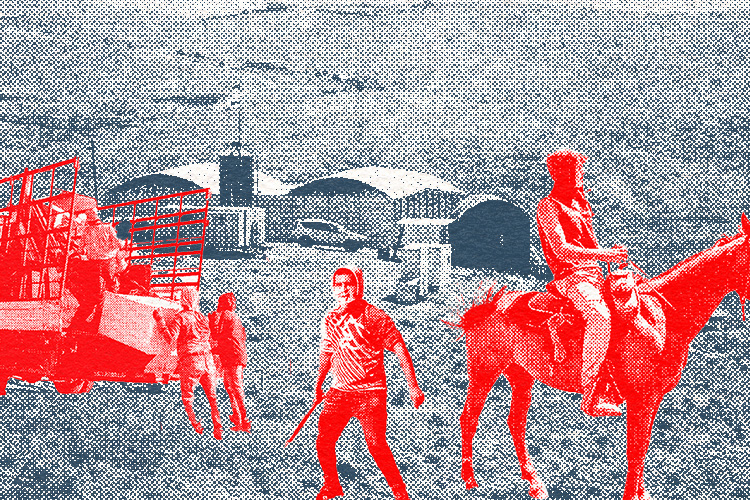
Despite the explicit prohibition in international law, Israel began building settlements shortly after capturing the territories. Over the years, the state officially advanced this policy through settlement planning, funding and regularization. The state also offered benefits and financial incentives to attract Israeli civilians to live in the occupied territory. Israel’s settlement policy has long drawn criticism from human rights organizations and the international community. It has also been challenged in Israeli courts. In the 1990s, negotiations between Israel and the Palestinians, international pressures and commitments made by Israel introduced political and bureaucratic barriers to settlement expansion. The backlash took the form of the unauthorized outpost system, designed to bypass approval procedures and establish facts on the ground. Unlike settlements, which, despite their illegality, are established with state approval, outposts are set up to deepen the Israeli presence in the occupied West Bank without a government resolution or the necessary approvals. This is why they are commonly called unauthorized outposts.
Although unauthorized outposts are established without formal state approval, the authorities materially and politically support them and refrain from taking enforcement measures. Most funding funneled to outposts is not allocated transparently, but ample evidence shows that they receive financial support from the state budget through government ministries, agencies, publicly funded nonprofit organizations, the World Zionist Organization, the Jewish National Fund and other bodies. This system of indirect support has allowed the state to maintain the appearance of upholding the law and present outposts as private initiatives outside its official policy, while benefiting from the facts established on the ground and using them to expand Israeli control over the West Bank. This policy of turning a blind eye and providing indirect support emboldens and backs those working to take over Palestinian land, including privately owned land.
Establishing an outpost begins with the unilateral, unauthorized takeover of land. Access roads are soon built, some cutting through private Palestinian land; open areas are fenced off; and Palestinians are denied access to their land. Though illegal, these actions are often carried out with a military escort and without meaningful enforcement by the authorities. In many cases, settlers living in outposts take over vast areas using illegal construction, extensive grazing, appropriation of natural water sources and, frequently, violence against Palestinians living nearby.
During the first decade of the 2000s, Israel made commitments internationally to freeze settlement construction and remove illegal outposts in the West Bank and told the Supreme Court it would enforce the law and remove them. Nevertheless, most outposts were not removed and continued to grow. In 2011, the government adopted a policy distinguishing between construction on privately owned Palestinian land, which was to be removed, and outposts on state land, whose retroactive approval could be considered. In subsequent years, the path to retroactive approval gradually expanded. The state also attempted to create mechanisms for retroactively approving construction on privately owned Palestinian land, including through the 2017 Expropriation Law (Regularization Law), which the High Court of Justice struck down.
Retroactive Approval and Accelerated Outpost Establishment
In recent years, particularly since Israel’s 37th government took office, the state has turned its longstanding policy of indirectly supporting unauthorized outposts under the guise of law enforcement into an official, proactive policy of retroactive approval. In February 2023, the Security Cabinet passed a resolution to retroactively approve ten unauthorized outposts and turn them into nine new settlements. That same month, it created a workaround for the regularization process, whereby outposts can be designated as “sites for regularization,” and as such, receive connections to infrastructure, public services and permission to build public buildings before they are formally regularized. Following this decision, Minister Smotrich instructed state services and infrastructure connections be provided to 68 unauthorized outposts. Some are undergoing retroactive approval and conversion into official settlements, while others have no legal prospect of approval. In June 2024, the Security Cabinet decided to retroactively approve five more unauthorized outposts and turn them into five new settlements. In March 2025, as part of a cabinet decision to establish 13 independent settlements, at least eight more unauthorized outposts previously established without a government resolution were retroactively approved. Of the 22 new settlements approved by the Security Cabinet in May 2025, 12 are unauthorized outposts established in recent years and retroactively recognized. This policy shows that Israel does not consider those establishing outposts as delinquents flouting building laws or criminal elements undermining its authority, but rather the vanguard realizing its territorial objectives on the ground: creating contiguous Israeli territory, taking over Palestinian land and displacing residents.
In addition to retroactive approval, the government has also increased financial support for outposts and farm outposts. In 2023, outposts and farm outposts received ILS 28 million (~ USD 9.2 million) through the Settlement Division. The 2024 state budget earmarked a further ILS 75 million (~ USD 24.6 million) for “young settlement,” covering road clearing, construction of fortified public buildings, “security components” and more. These measures have come with an unprecedented surge in the number of new unauthorized outposts and the pace at which they are established in recent years. According to Peace Now data, for example, approximately 140 new unauthorized outposts were established across the West Bank between 2000 and 2022. By contrast, from January 2023 to August 2026, Israeli civilians established 231 new outposts in the West Bank. Military data also show a sharp increase in outposts classified as “farm outposts,” from approximately 30 before October 2023 to approximately 120 in July 2025.
The Era of Farm Outposts: The Era of Violence and Expulsion
Farm outposts, which account for a significant proportion of the outposts established in recent years, are usually set up in areas inhabited by Palestinian shepherding communities. They have few residents, sometimes a young family and a handful of volunteers. Despite the small number of residents, farm outposts have become a central tool for taking over vast areas through grazing, blocking access roads, appropriating resources and inflicting sustained violence on Palestinian communities.
The establishment of farm outposts near Palestinian shepherding communities has significantly increased direct violence against them. Settlers from these outposts graze their flocks across vast areas to take control of the space, deny communities access to pastureland, and reduce the area available to them. Settlers, often armed, also assault Palestinians, damage their property, hurt animals, harass residents and make explicit threats, demanding they leave their homes. This violence continues, almost undeterred, given the persistent and systematic failure of law enforcement agencies to investigate and prosecute Israelis who harm Palestinians. Meanwhile, the military has stepped up the execution of demolition orders against Palestinian communities, including water cisterns, agricultural structures, public buildings and homes. The combination of settler violence and Israel’s ongoing institutional oppression has created untenable living conditions and led to the forcible displacement of dozens of Palestinian shepherding communities.
In less than two years, an area spanning approximately 100,000 dunams east of Allon Road was almost entirely emptied of its Palestinian residents, who had lived there for decades. According to a joint report by Yesh Din and Physicians for Human Rights Israel, the deliberate absence of effective law enforcement against violence originating from these outposts, the state mechanisms that enable the violence and its consequences and the benefits Israel derives from the outcome, establish Israel’s responsibility for the war crime of forcible transfer. This pattern also indicates the ethnic cleansing practices in certain parts of the West Bank, meaning using force or other coercive measures to remove an ethnic group from a particular area in order to change its demographic composition.
According to a report by Peace Now and Kerem Navot, as of July 2026, farm outposts control more than one million dunams, approximately 18% of the West Bank. Approximately 35% of this land is privately owned by Palestinians. Most farm outposts were established in areas designated as Area C. In 2024, however, settlers began establishing new outposts in Area B as well, in places previously free of Israeli settlements.
Although farm outposts are established without official approval and in violation of the law, evidence indicates that at least some were established with the military’s knowledge and in coordination with it. A military officer interviewed for a December 2025 investigation by Zman Emet, a program on Israel’s public broadcaster, claimed that farms had been established on the instructions of GOC Central Command Avi Bluth. According to an April 2026 report in Haaretz, Bluth himself told a closed forum that 150 farm outposts had been established in coordination with the military. Even when outposts are established without prior coordination, once they are in place, the military provides protection, assigning substantial forces to the task. Outposts ostensibly established in violation of the law thus receive military protection, enabling them take root.
A striking example of how the state supports the spread of farm outposts is the allocation of land for grazing. On February 10, 2025, the Civil Administration announced six pastureland allocations across the West Bank, totaling 16,121 dunams, an enormous area of more than 16 square kilometers. These allocations considerably expand Israeli control over open areas in the West Bank, as part of an ongoing policy of transferring land for the settlement enterprise.
The retroactive approval of unauthorized outposts, in combination with the establishment of dozens of new farm outposts and the allocation of pastureland for them, effectively advances the West Bank’s annexation by expanding Israeli presence and imposing permanent civilian rule. At the same time, Palestinians are pushed into a series of disconnected enclaves with no territorial contiguity or any real prospects for development and no ability to exercise collective rights. Taken together, these measures reflect an intensification and acceleration of Israel’s annexation policy in the West Bank, expanding its presence and deepening its control over the territory in violation of international law.

 Disable/Enable big cursor white
 Disable/Enable big cursor black