
The year preceding the olive harvest has been particularly difficult for Palestinian farmers, given the war in Gaza and escalating settler violence in the West Bank. Farmers have faced significant obstacles in accessing and cultivating their farmlands, including areas where they are not required to “coordinate” access with the army. Meanwhile, growing economic hardship in the West Bank due to the ban Israel has imposed on the entry of Palestinian laborers into its territory since October 7 has increased the reliance of Palestinian families on their olive crops.
The West Bank olive harvest, slated to begin on October 15, 2024, faced severe disruptions throughout the West Bank, with Palestinians often unable to harvest altogether as Israeli soldiers and settlers assaulted them, forced them out of their lands or otherwise obstructed them. In the Palestinian village of Faqqu’a, in Jenin District, soldiers fired at a family of Palestinian olive harvesters on their own land, killing local resident Hanan ‘Abd a-Rahman Abu Salameh, 59.
>>> For the full list of harvest-related incidents documented by Yesh Din – click here
This year, Israeli security forces appeared to have played a greater role in obstructing the olive harvest. Soldiers, Border Police officers and settlement Civilian Security Coordinators (CSCs) often prevented Palestinians from accessing and harvesting in their own lands, or failed to stop settlers who harassed or assaulted them. Adding to this, the Military Commander of the West Bank issued closure orders for extensive areas containing Palestinian agricultural lands, completely barring Palestinian access to these areas.
The “coordination mechanism” created by the army more than a decade ago purportedly aims to protect Palestinians from settler violence and enable a safe harvest. In practice, however, it is used as a tool for preventing it. As part of this mechanism, the military denies Palestinian farmers access to their privately-owned lands near Israeli settlements and outposts other than during the plowing period in the spring and the olive harvest in the fall. When access is permitted, the army is meant to coordinate dates for Palestinian farmers to harvest and engage in other agricultural work under protective military presence.
The military sets these dates without consideration for the farmers’ needs. This year, in many places, no coordination was made at all, and where dates were provided, the military communicated the arrangements to Palestinian residents haphazardly and last minute. In many instances, coordination details were centrally transferred to Palestinian council heads with one day’s notice, and farmers were given only one or two days to harvest – neither enough time to prepare for the harvest, nor complete it.
While Palestinian farmers were blocked from reaching their lands near settlements and outposts, settlers enjoyed free access to them and took full advantage of the situation to harvest private Palestinian lands unimpeded. More incidents of crop theft by settlers were recorded this year compared to previous years, often in the presence of soldiers or other Israeli security forces who did nothing to stop them.
N., 45, from the village of Immatin, told Yesh Din:
“On Saturday, October 28, 2024, my uncle got a message that there was coordination for the harvest the next day on the north side of our area. I left the village with three of my brothers, my mother, my wife, and our cousins, a total of 10 people, at 8:00 A.M.
We drove to the land by tractor and trailer and arrived at 8:20 A.M. When we got there, we discovered the olives had already been stolen. While my wife, brother, and I were pruning a tree, two vehicles arrived from the direction of the Gilad Farm outpost up to 10 meters from the plot. Three men, one in uniform and two in civilian clothes, got out and fired in the air. I walked towards the settlers and told them in Hebrew that we were going to leave. The uniformed man fired an M16 rifle in the air, and I turned around to go back to my family.
Then I felt an injury and fell. I heard a lot of gunshots. I couldn’t get up on my own. I touched my leg below the knee and felt a lot of blood. I screamed for help, and my wife screamed too. They kept shooting at one of my brothers and at the ladder. Another brother tried to get closer and was injured by a fragment.
The whole thing lasted about 10 minutes. My wife and nephew picked me up and took me to the tractor, and we drove on dirt roads to the village. We got to the Karnei Shomron settlement area, and from there, a Palestinian ambulance took me to the hospital in Qalqiliyah. I stayed in hospital for six days and had two operations. Now I’m in bed at home.”

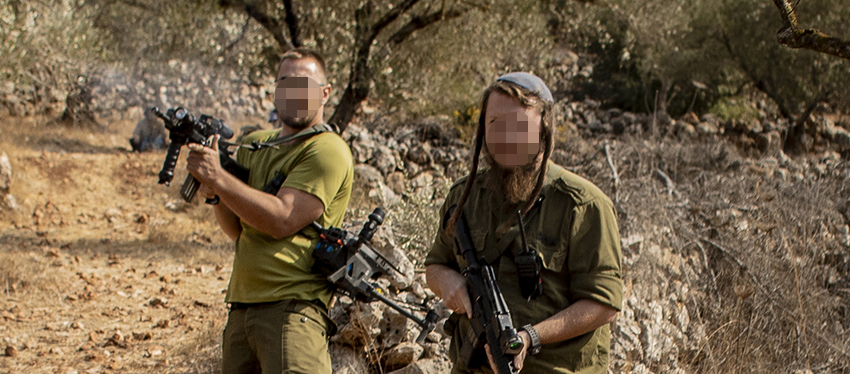
Settlers and soldiers force out Palestinian harvesters on lands in the village of Yatma, October 18, 2024. Photo: Yatma Village Council
113 incidents of violence over a six-week harvest (2.5 incidents on average per day)
Between October 1 and November 15, 2024, Yesh Din documented 113 separate incidents of violence, harassment, harvest thwarting or damage to olive trees and crops involving Israeli civilians and soldiers. These incidents took place throughout the West Bank, on lands belonging to 51 Palestinian villages, towns and communities. All of theses incidents are listed here.
The data does not cover all incidents of harvest-related violence in the West Bank during this period, but rather only those documented and verified by Yesh Din (the below list of incidents by type exceeds 113 as some of incidents fell under more than one category).
- In 68 incidents, settlers and soldiers forcibly prevented Palestinians from harvesting their olive trees. In approximately 70% of these incidents, personnel armed and funded by the State of Israel (military, police, settlement CSCs) were present at the scene, but instead of protecting the Palestinian harvesters, as their duty demands, they worked together with the settlers to prevent the harvest.
- In 43 incidents, physical violence was used against Palestinian harvesters. In these cases, settlers and soldiers attacked, beat, or threatened harvesters, including eight cases of live fire directed at Palestinian farmers. In one incident, soldiers shot and killed a 59-year-old Palestinian woman from the village of Faqqu’a in the northern West Bank.
- 52 incidents of theft or damage to Palestinian property. Settlers stole crops and agricultural equipment, damaged property, and set fire to vehicles. In 38 of these incidents, settlers harvested or stole olives on lands belonging to Palestinians.
- 12 cases of damage to olive trees, including cutting down, sawing and torching trees. In total, hundreds of olive trees belonging to Palestinians were damaged or cut down.


 Disable/Enable big cursor white
 Disable/Enable big cursor black